
A father starts having difficulty doing things he used to do without thinking.

Verified Biologics
Behind every chart, scan, laboratory sample and research study is a person.
A parent. A spouse. A child. A friend. Maybe you.
That is why progress matters.
Why it matters
Cells. Tissues. Laboratories. Research papers. Clinical studies. Cold storage, documentation, lot numbers, review committees. That is the scientific side of this story, and it deserves to be taken seriously.
But there is another side, and it rarely appears in a research summary.
The people waiting for discoveries. The families hoping for progress. The researchers who have spent years on a question that still does not have a clean answer. The physicians who would like more to offer than they currently have.
None of them are abstractions. They are the reason any of this work continues at all.
We believe the future of medicine should be measured not only by what science discovers, but by what those discoveries may ultimately mean for human lives.

Plain English, please
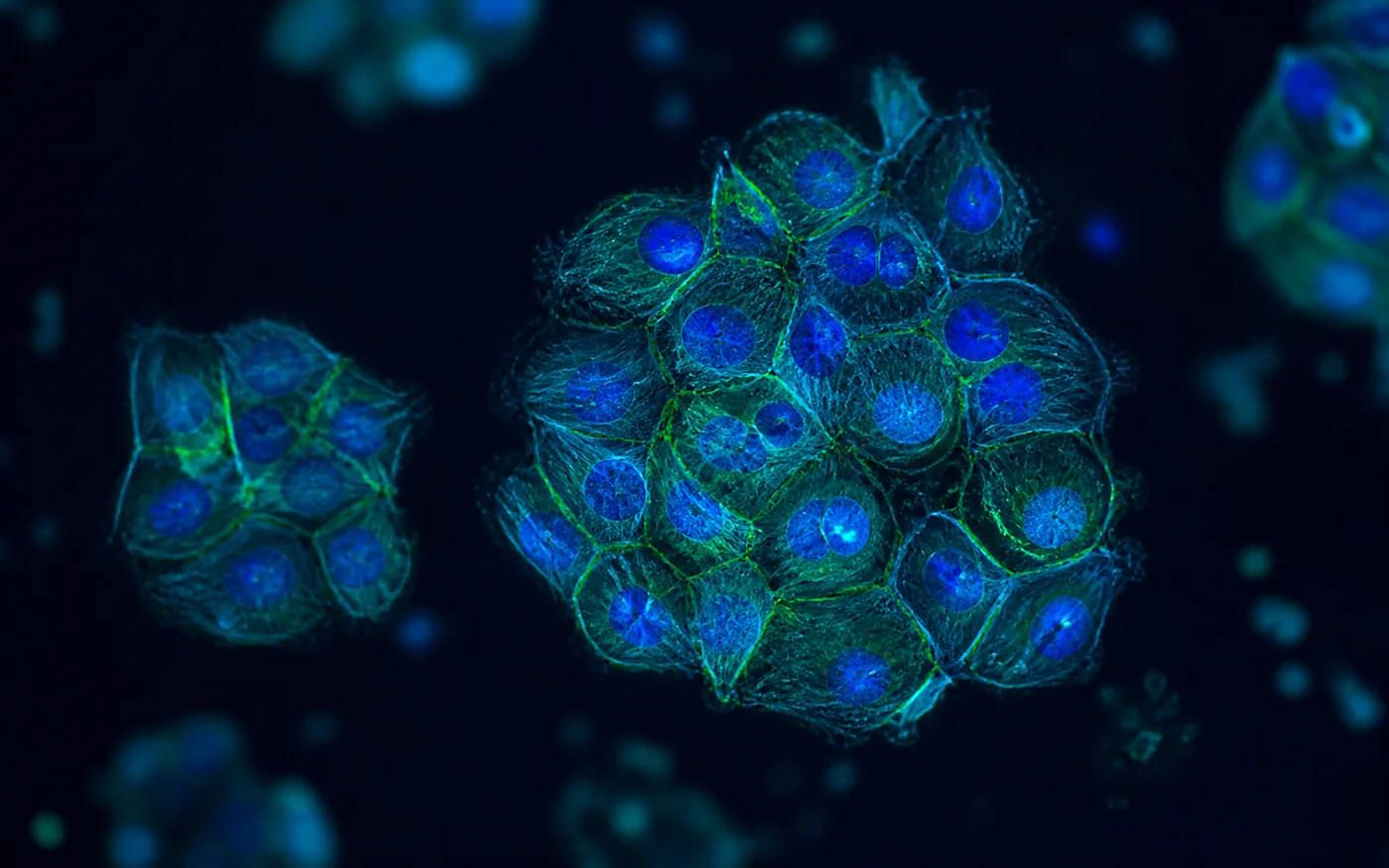
Your body is made of trillions of cells. They build your tissues, carry oxygen, help defend you from infection, and perform countless jobs that keep you alive — mostly without you ever thinking about it.
A tablet or an injection usually delivers a chemical compound. It travels through the body, interacts with something, and is eventually cleared out. It does roughly the same thing wherever it goes.
Here the thing being delivered is not a molecule at all. It is living cells — which sense their surroundings, release signals, and can behave differently in one situation than another. That responsiveness is exactly what makes them interesting, and exactly what makes them harder to study.
Scientists are studying how different types of cells behave, and how cellular technologies may potentially be used in medicine. Here is the path that research follows.
The starting unit. Every part of you is built from cells, each doing a job.
Cells of similar kinds working together — muscle, skin, bone, blood.
Tissues organised into organs and systems that keep you going every day.
Scientists study how cells behave, communicate, repair and change.
Some of that understanding becomes established medicine. Much of it is still being investigated.
Some forms of cell therapy are established medicine and have been for decades. Many others are still being investigated, meaning the results are not yet in. Those are two very different statements, and we will always tell you which one applies.

Stem cells
Think of stem cells as cells with possibilities. Unlike many cells that already have one specialised job, certain stem cells can develop into other types of cells under the right conditions.
A muscle cell contracts. A red blood cell carries oxygen. A skin cell forms a barrier. Each has settled into a specialty. Stem cells have not. They can also make more copies of themselves, which means a small number can keep a supply going.
That combination — the ability to renew, and the ability to become something more specialised — is why researchers keep coming back to them. A cell that can become other cells is a cell that can help study biological processes which are difficult to reach any other way.
And there is a second reason: honesty about what we do and do not yet understand is where the most interesting questions live.
We publish that third column deliberately. A company unwilling to describe the limits of the science is not describing the science.
What it could mean
These are the possibilities researchers around the world are working toward.
Because behind every cell being studied is something much bigger than the cell itself.
A memory. A movement. A moment. A person. A life.
A father starts having difficulty doing things he used to do without thinking.
A grandfather wants more afternoons like this one.

A couple who have been active their whole lives would like to stay that way.

A daughter watches her parents get older and wishes there were more options.
The people pictured on this website are not Verified Biologics patients or customers, and these images do not represent anyone's medical experience or outcome. They are here for one reason: to keep the human stakes of responsible medical research visible.
Verified Biologics
Verified Biologics works within the biologics and regenerative medicine field, supporting healthcare professionals, researchers and organisations with biologic products, education, sourcing and scientific collaboration.
Biologic products made available to qualified professionals and organisations, with the source, handling requirements and documentation described clearly rather than assumed.
Plain-language explanations of stem cells, cell therapy, biologics and the difference between established medicine and active research. Written for people, not for journals.
Working with manufacturers, laboratories, clinicians and research organisations. The specific scope of our sourcing and collaboration activity is described on the About page.
Our name is a commitment
We put the word Verified in our name, which means we should be able to say what it stands for. These are the five things we believe every biologic product should be able to answer.
Know where a product comes from.
Important information should be available — and understandable.
Biologic materials require appropriate handling and storage.
Products should be identifiable through appropriate records and lot information.
Healthcare professionals deserve clear information about what they are considering.
Education Center
Straight answers to the questions people actually ask — not the questions a marketing department wishes they would ask.
Most cells in your body already have one job. Stem cells are different — they still have options. Here is what that actually means, in everyday language.
It is a field of study, not a product. Here is the idea behind it and where it currently stands.
The idea is straightforward: use cells themselves as the medicine. The details are where it gets interesting.
It is a specific, narrow statement — and it is used loosely far more often than it is used correctly.
It means the question is still open. That is a legitimate and important stage — as long as it is described honestly.
A practical checklist. Good answers are specific. Vague answers tell you something too.
For professionals
If you are a physician, researcher, laboratory or organisation evaluating biologic products, the professional area of this site goes considerably deeper — product information, documentation, storage and handling, ordering and regulatory questions.

Next step
Whether you want to understand the science or evaluate a specific product, we would rather have a clear conversation than a persuasive one. If we do not know something, we will say so.
Important: This website is provided for general information and education. Nothing here is medical advice, a diagnosis, a treatment recommendation, or an offer to treat any condition. Descriptions of research describe areas of scientific study, not established outcomes. Products are made available only in accordance with their applicable regulatory status. Read the full medical and regulatory disclaimer.